Two facelift quotations are only comparable when they describe the same areas, intended changes, care arrangements and exclusions. A technique name or a total price is not enough. Ask each surgeon to translate the proposed plan into ordinary language: what it aims to change, what it will leave unchanged, what risks it carries and what happens after the operation.
This article is a practical guide to reviewing proposals, not a test for deciding which operation you need. It is for people considering facial rejuvenation in Korea who have encountered terms such as face lift, neck lift, mini lift, skin tightening or combined treatment and want to ask more useful questions. A personal examination and a qualified clinician’s assessment remain essential.
Describe your priorities before comparing techniques
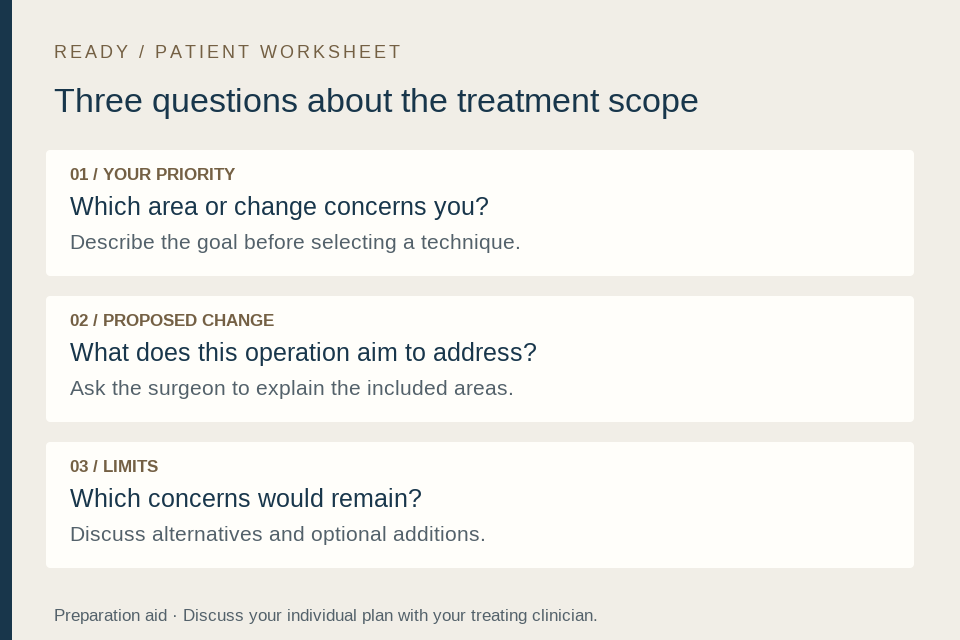
Begin with the changes that prompted your enquiry. You may be concerned about the lower face, the jawline, the neck, the surface of the skin or several things together. Describe them without assigning a treatment. The point is to help the surgeon explain whether your different concerns belong in one plan or require separate conversations.
Write down what you would like to preserve as well. Some people prioritize keeping their familiar expression; others want to avoid a particular scar location or need to understand how treatment could fit around work. These preferences do not dictate a clinically suitable procedure, but they help make the consultation more personal than a comparison of promotional photographs.
Bring relevant treatment history. Include earlier facial operations, injections, threads and device treatments where known, together with dates and available records. If you are unsure what a previous product was, label that uncertainty. ASPS consultation guidance includes discussion of previous treatment, health conditions, medicines and goals; it also describes examination and photography as possible parts of assessment. [1]
Ask for a map of the areas being treated
A useful written proposal identifies the areas included in the operation. Ask the surgeon to show you which parts of the face and neck they intend to address, using a mirror, an annotated photograph or another explanation you can understand. Then ask which of your stated concerns fall outside that scope. This is more informative than assuming the word facelift includes every visible sign of aging.
ASPS describes facelift surgery as addressing signs of aging in the face and neck, while explaining that it does not stop aging and that some concerns may require other treatments. Its general description is a starting point for questions, not proof that every named facelift includes the same work. Ask for your actual proposed operation, not a definition copied from a clinic brochure. [2]
If the surgeon recommends neck treatment, ask whether it is included in the quoted operation or is a separate component. If brow, eyelid or other treatment is mentioned, request the same clarification. Do not infer coverage from the way a package is photographed or from the order in which procedures appear on the website.
Separate tissue lifting from skin-quality concerns
A plan can become confusing when surgical lifting, injectables and skin treatments are presented under the same rejuvenation heading. Ask what each proposed component is meant to achieve. Which concern is the operation intended to address? Which concern motivates a separate skin treatment? What would the plan look like if you chose only one component or postponed the others?
ASPS notes that nonsurgical rejuvenation does not achieve the same results as a surgical neck lift, although selected treatments may complement surgery or serve different goals. That does not mean an operation is automatically the better choice. The relevant question is whether the benefits and limitations of the proposed approach fit your situation and preferences. [3]
Avoid treating “less invasive” as a promise of no risk or “more extensive” as a promise of a better result. Ask about the limitations, expected follow-up and individual risks of each option. A clear consultation can also conclude that treatment is not appropriate now. You do not need to agree to a combination simply because the clinic can offer several procedures.
Translate the technique name into a patient explanation
You may encounter names referring to the depth, extent or style of a facelift. Instead of deciding from the label, ask the surgeon what that term means in their proposed operation. Ask where incisions would be placed, what areas would be treated and why this approach is being considered for you. A name cannot replace that explanation.
If two surgeons recommend different approaches, ask each to explain their reasoning in relation to your goals and examination. Write their explanations side by side. A disagreement is not automatically evidence that one proposal is wrong, but it is a reason to clarify the difference before choosing. You should be able to identify what would change for you, not merely which terminology sounds more advanced.
Ask what would cause the plan to change after an in-person examination. A remote estimate may be provisional. If a package has already been discussed, confirm how additional recommendations would affect the fee, your consent and your right to decline. Do not assume that travelling to Korea creates an obligation to proceed with a different operation than the one you expected.
Ask for the version of the plan without the optional addition
A proposal can be clinically coherent while including changes you did not set out to make. Imagine you asked about your jawline, and the proposal also includes an eyelid operation. Ask the surgeon to walk through a jawline-only plan first. Which part of your original goal would it address? What would remain visible in the upper face? Then ask what the extra operation would change and which additional incision, recovery tasks, risks and follow-up it introduces. Let the surgeon explain if omitting a component would make the remaining plan unsuitable.
Record three answers for each optional component: the feature it is intended to change, the trade-off it adds and whether you would want it as a separate decision. Someone may accept an eye procedure because it addresses a longstanding concern, while another person wants to keep the same feature. Both patients can ask the same questions and make different choices.
Ask for the written estimate and proposed consent discussion to reflect the version you actually want assessed. If the names in the price list group several procedures together, invite the team to cross-reference them to your list. A term such as “full face” should not leave you guessing whether a brow, eyelid or neck operation is included. The American Society of Plastic Surgeons describes brow and eyelid procedures as operations that may accompany a facelift. An association between procedures is a reason to ask about scope, not an indication that you personally need every component.
American Society of Plastic Surgeons overview of facelift surgery and associated procedures
Read the quotation line by line
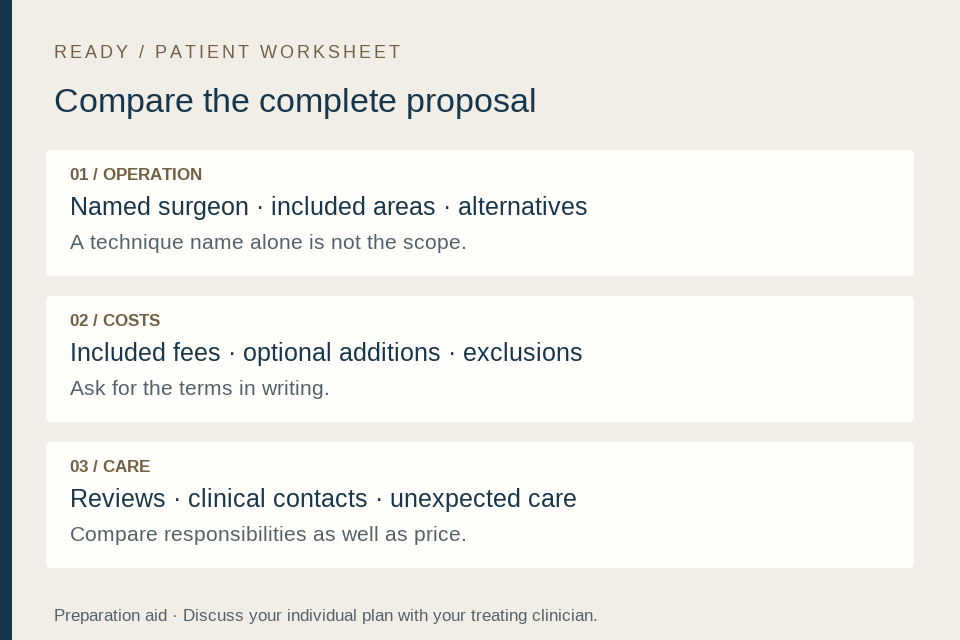
Create a comparison sheet with the same headings for every clinic: named surgeon, procedure scope, anesthesia arrangements, facility charges, examinations, prescribed medicines, planned reviews and exclusions. Ask the clinic to mark whether each item is included, separately charged or still undecided. This is an organizational tool, not a demand that every practice price its services identically.
Keep optional additions separate from the core proposal. If a skin treatment or another procedure appears in the quote, ask whether it is necessary for the agreed goal, optional, or recommended for a different concern. Request a version showing the plan without optional additions so you can understand the decision and financial commitment independently.
Confirm currency, taxes, deposit terms and cancellation conditions in writing. Ask how a change in clinical recommendation before surgery affects any money already paid. READY does not publish a verified personal price for your treatment. Its cost-planning guide can help you organize questions, but the clinic must supply the actual terms.
Make risk discussions specific enough to be useful
Ask the surgeon which risks matter particularly for your health and proposed operation. ASPS lists bleeding, infection, anesthesia risks, altered sensation, facial-nerve injury, healing problems and hair loss around incisions among possible facelift complications. A list is not a personal risk estimate. Ask what the team does to reduce relevant risks and how a problem would be recognized and managed. [4]
Include scars and possible dissatisfaction in the discussion. Ask where incisions are expected, what follow-up is provided and what limits remain even if healing proceeds as anticipated. If the clinic shows photographs, ask what procedures were performed and when the images were taken. Selected results can illustrate possibilities, but they cannot establish what will happen for you.
Do not accept a promise of a specific number of years younger, an invisible scar or a risk-free operation as a substitute for informed consent. You can ask for further explanation, request time to think or seek another opinion. The purpose of preparation is not to become your own surgeon; it is to understand the decision well enough to make it voluntarily.
Compare recovery responsibilities, not just downtime
Ask what help you may need after the procedure and who provides it. Clarify the planned review schedule, practical restrictions the clinician expects to discuss, and the conditions for returning to work or travel. These are separate questions. A date when someone might feel comfortable appearing in public does not establish that they are ready for a long journey or physically demanding work.
Discuss your real circumstances rather than asking only for the shortest possible recovery estimate. Explain whether you live alone, have caregiving responsibilities or have limited flexibility at work. Ask what arrangements would need to change if recovery takes longer than anticipated. Do not build a fixed itinerary around another patient’s experience or the most optimistic date in a marketing message.
Ask who handles postoperative questions after you leave Korea, and which reviews require an in-person appointment. If extra treatment becomes necessary, clarify what the clinic’s policy covers and what it excludes. The NHS emphasizes planning follow-up and unexpected costs when considering cosmetic surgery abroad. That advice does not establish any particular Korean clinic’s contractual responsibilities. [5]
A relevant READY clinic for comparing options
Good-Line Plastic Surgery is relevant to this topic because its current international introduction describes face and neck lifting alongside nonsurgical skin care. It identifies Dr. Choi Deokho as the clinic’s lead surgeon. Those published services make it a useful practice to ask about the distinction between a lifting operation and additional skin-focused treatment; they do not establish that a combination is suitable for you. [6]
Read the Good-Line clinic profile, its face and neck lifting page and Dr. Choi’s profile. Then use the clinic’s international website to request a consultation about your own priorities. Ask for the proposed scope, alternatives and an itemized quotation before comparing it with another plan.
A clinic listing is not proof of clinical superiority. The clinic’s description of its physician and services is self-reported. This article does not independently verify licensing, rank the practice against all clinics in Korea or endorse a particular operation.
A practical way to review two proposals
After each consultation, write a short summary using the same five prompts: my priority, the proposed change, the concerns that would remain, the main trade-offs, and the follow-up commitment. Add questions you could not answer confidently. Send those questions back before treating the proposal as complete. A cheaper quotation with a missing explanation is not yet a fair comparison.
Look for differences that change your decision. One proposal may cover different areas, include additional procedures or require different arrangements after surgery. Ask the clinic to explain those differences rather than trying to negotiate two unlike plans into the same price. If you still cannot explain what you would be agreeing to, pause the booking process.
Is a mini facelift always the smaller commitment?
Ask what the clinic means by that name and what the proposed operation includes. Do not infer the incision pattern, anesthesia, recovery or cost from a label alone. Compare the written scope and the surgeon’s explanation of what it can and cannot address.
Should I combine a facelift with skin treatment?
That requires an individual assessment. Ask what separate concern the additional treatment is intended to address, what alternatives exist and whether the timing matters. You can request a plan that separates essential recommendations from optional additions and decide after understanding both.
Can I choose from before-and-after photos?
Photographs can support a conversation, but they should not be the entire decision. Ask about the procedures, timing and context behind the examples and discuss cases relevant to your own concerns. Combine that discussion with the surgeon’s explanation of suitability, risks and follow-up. READY’s facelift overview provides the broader starting point.