A useful revision-rhinoplasty consultation begins with a clear account of your earlier treatment, what concerns you now, and what you hope another assessment will answer. Before choosing a technique or requesting a price, organize those three things. A previous operation does not automatically mean you need another one, and an online photograph cannot establish what further surgery would involve.
This guide helps you prepare a concise information pack for a consultation in Korea. It is particularly useful if your original operation took place elsewhere, your records are incomplete, or your appearance concerns sit alongside breathing symptoms. It does not determine whether revision is appropriate or when you should have surgery. Those decisions require an individual assessment by the treating clinician.
Start with a question, not a preferred operation
Try writing one sentence that describes why you are seeking another opinion. For example, you may want to understand a change in shape, ask about persistent dissatisfaction, or discuss difficulty breathing. These are examples of consultation questions, not explanations of what has happened inside your nose. Avoid assigning a diagnosis from a forum or deciding that a particular graft is the solution before examination.
Then separate your concerns into appearance, function and expectations. Under appearance, describe the feature that bothers you in your own words. Under function, record what you notice about breathing and when it occurs. Under expectations, explain what you would prefer to preserve. Keeping these categories separate makes it easier to ask whether one proposed treatment addresses all your concerns or only some of them.
The American Society of Plastic Surgeons describes discussion of both appearance and breathing goals, previous operations, medical history and medicines as part of rhinoplasty consultation. Its guidance is general; it does not establish a Korean clinic’s examination protocol. Use it to prepare your information, then ask the clinic what else the surgeon needs. [1]
Build a timeline that another doctor can follow
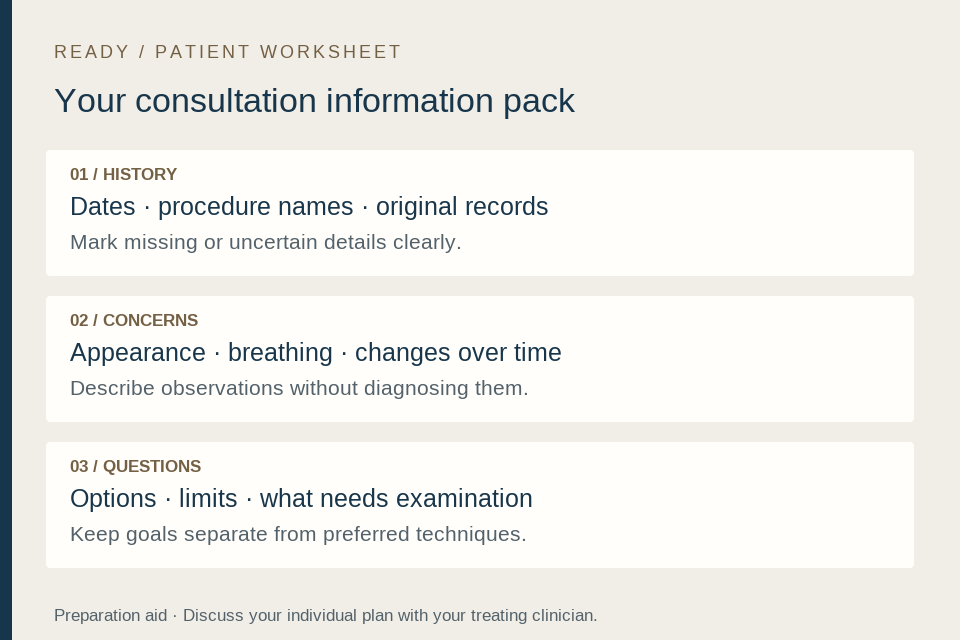
Create a dated list of earlier nasal operations and other relevant treatments. Include the month and year where you know them, the clinic and treating doctor, and the name used for the procedure. If you only remember an approximate date, label it approximate. A candid record with clear gaps is more useful than a polished summary containing guesses.
For each entry, add what you were told was done and where that information came from. Distinguish your memory from an operative report or a clinician’s written explanation. A quotation may describe the intended operation; it is not necessarily a record of everything actually performed. Keep both documents if you have them, but label their purpose so a new clinician can interpret them correctly.
Add subsequent visits or interventions that you think may be relevant. Note when your current concern became noticeable and whether it has changed. You do not need to produce a medical conclusion. A short factual account gives the surgeon something to clarify during the appointment and helps prevent important details being lost in a long messaging conversation.
Ask the original clinic for specific documents
Request copies of the operative report, discharge or treatment summary, and any available implant or graft information. Ask for the original documents rather than relying solely on a new marketing-style summary. If the clinic cannot supply something, record that response. Do not assume that an unavailable document proves either good or poor treatment; it simply leaves an information gap for the next assessment.
If materials were used, bring the information you received about them. That might include an implant label, product details or a description in the operation notes. Do not identify a material by its appearance in a photograph or by what is commonly used at that clinic. Ask the reviewing surgeon how uncertainty about previous materials affects the assessment and whether further information is needed.
Keep original-language records alongside any translation. Ask the receiving clinic what translation format it accepts and which documents are worth translating first. Translating a large folder before checking can create unnecessary work. Names, dates and the distinction between a proposed procedure and a completed procedure deserve particular attention, because a small translation mistake can change the meaning of the history.
You have the scan report. Does the surgeon also need the images?
A report is the radiologist’s written interpretation. The original imaging study contains the views the receiving clinician can inspect. A screenshot of one slice on your phone is a third, more limited item. If a clinic in Seoul asks for “your CT,” ask which of these it means, which examination date it needs and whether it can open the format offered by the radiology department.
Suppose you have the report from your previous clinic, but the link to the images has expired. Contact the imaging facility through its official records service. Ask whether it can issue another secure link, share the study directly with the receiving facility with your consent, or provide the images in a format the clinic accepts. Ask the clinic in Korea to confirm receipt and that its team can open the files before your appointment. A message saying “file uploaded” does not show that a clinician could view the series.
Do not arrange another scan simply to fill a gap in a travel folder. Tell the surgeon which study exists, why it was obtained and what is missing. Let the treating clinician decide whether existing records are sufficient or whether another examination is indicated. If names, dates or sides differ between the report and the operation notes, keep both originals and flag the discrepancy. For a revision opinion, an honest account of a missing study is more useful than an incorrectly labelled image.
RadiologyInfo guidance on obtaining and sharing imaging studies
Record missing information without filling the gaps yourself
Use one line per earlier procedure: date; clinic and clinician; planned procedure; confirmed procedure; source document; unresolved question. For example, “June 2024; original clinic; nasal surgery; exact graft details not confirmed; invoice available, operative report requested.” This is an organizational example, not a medical record to copy into your own history.
Keep three evidence labels: documented, remembered, and not known. If an invoice names an implant but you cannot confirm that it was used, keep it under planned or unconfirmed treatment. If the clinic sends a correction later, retain the dated original and the correction together. Ask the new surgeon which missing facts matter to the decision and which can be clarified by examination. Do not buy imaging or other tests just to complete the folder unless a clinician recommends them.
At the appointment, ask for the same separation in the proposed plan: what the examination establishes, what remains uncertain, and how that uncertainty could change the operation. Ask specifically whether the plan addresses appearance, airflow or both, and which concern may remain. A detailed folder supports the consultation; it cannot replace an examination or guarantee that revision will help. [1], [2]
Choose photographs that explain the history
If you already have dated photographs from before and after your earlier treatment, organize them chronologically. Preserve the original files where possible. A simple filename or note can identify the date and whether an image was taken before treatment, during early recovery or later. If you do not know the date, say so rather than giving an impression of precision.
Use pictures to illustrate your question, not to prove a diagnosis. Lighting, camera distance, angle and facial expression can change how a nose looks. Ask the clinic for its current photo instructions if it offers a preliminary remote review. Do not edit the shape, use a beauty filter or assemble different views in a way that hides which image belongs to which stage.
Reference photographs can help explain a preference, but another person’s nose is not a promise about your result. Instead of saying “make it exactly like this,” identify the quality you are trying to discuss. Ask what your own anatomy and treatment history may limit. READY’s guide to reading before-and-after photographs explains how to approach clinic galleries without treating selected examples as predictions.
Make a health summary without changing your treatment
Prepare a current list of prescribed medicines, non-prescription products and supplements, together with allergies and relevant health conditions. Bring the names and instructions from their packaging or your prescription record if you are unsure. Include information about smoking or nicotine use honestly when the clinician asks. This is a conversation about assessment, not an opportunity to improve your apparent suitability by leaving things out.
Do not stop, restart or change a medicine because a general online checklist mentions surgery. Ask the surgical team and the clinician who prescribed it to coordinate any necessary instructions. If different clinicians give you conflicting advice, seek clarification before acting. A document pack should support safe communication rather than become a set of self-directed medical preparations.
Keep your questions about symptoms distinct from administrative questions. A coordinator may help arrange documents and appointments, but ask which clinical questions need the surgeon’s response. If your concern is new, worsening or feels urgent, seek appropriate medical assessment rather than waiting for an overseas cosmetic consultation. This article cannot tell whether a symptom is related to your earlier operation.
Understand what a remote opinion can and cannot settle
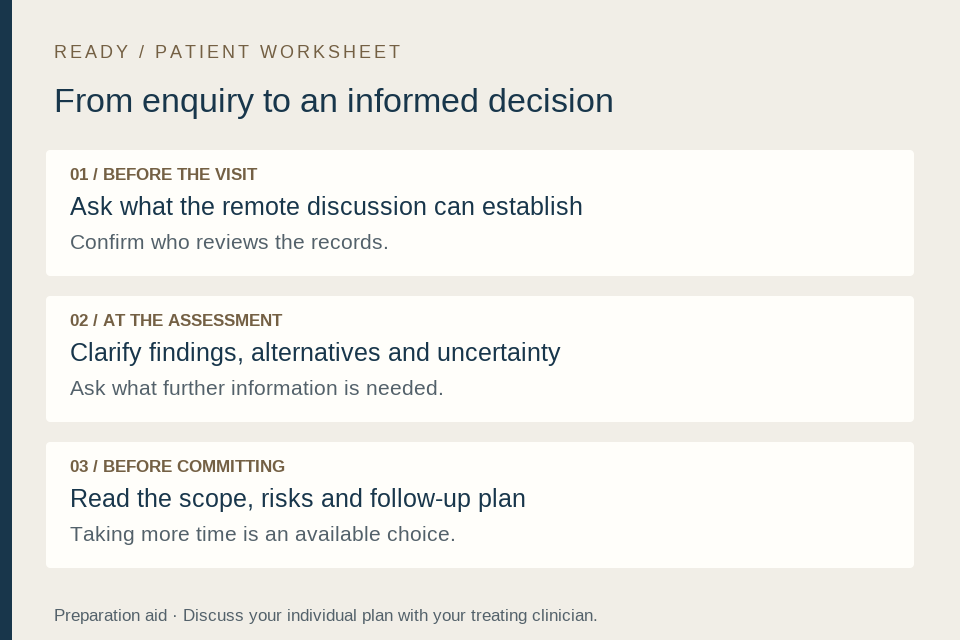
Before paying for travel, ask what the first remote exchange actually provides. Is it an administrative screening, a discussion with the surgeon, or an initial estimate that may change after examination? Ask who reviews your records and how their name will appear on the consultation booking. A smooth messaging service does not, by itself, establish who will make the clinical decisions.
Request a list of unresolved questions after that exchange. You might need an examination before the surgeon can explain the cause of a concern, assess options or make a final recommendation. An honest explanation of uncertainty is useful information. Be cautious about interpreting a confident answer based on a few photographs as a complete assessment, especially when records or earlier materials remain unclear.
Ask whether the clinic would advise waiting, further investigation, another type of assessment or no additional surgery. The aim is to understand the available choices, including their limits. If you seek a second opinion, send the same factual pack and ask the same central questions. That makes differences in reasoning easier to understand without expecting two clinicians to propose identical plans.
Review the proposed plan in ordinary language
Ask the surgeon to explain what they believe is causing the concern, what the proposed treatment would attempt to change, and what would probably remain. If a graft or implant is proposed, ask why it is being considered for your case and what alternatives exist. Do not choose a material solely because a clinic describes it as natural or advanced.
Discuss risks as well as the intended change. ASPS lists possible breathing difficulty, infection, altered sensation, poor healing, unsatisfactory appearance and a need for further revision among rhinoplasty risks. These are not individual probabilities and are not a complete account of your situation. Ask which risks are especially relevant to your previous treatment and how the team would manage them. [2]
Recovery also needs its own conversation. ASPS notes that nasal appearance can continue refining for up to a year after rhinoplasty. That general observation does not decide when your particular concern should be assessed or when another operation is appropriate. Ask how the surgeon distinguishes ongoing healing from an issue that needs another response. Avoid setting a revision date from a generic online timetable. [3]
A listed clinic to consider for this discussion
JNB Clinic is a relevant starting point within READY’s listed collection because its international physician biography describes Dr. JuYong Kang’s work in rhinoplasty and nasal-airway reconstruction. His published specialty is otolaryngology, or ENT. That should not be confused with independent verification of plastic-surgery board certification. The biography is clinic-reported information, and suitability remains a consultation decision. [4]
Review the JNB clinic profile and Dr. Kang’s profile before sending your records. The clinic’s international website is the appropriate next step for asking whether it can assess your particular history, which records it needs and who would see you. Do not send a full medical archive to an unverified social-media account; confirm the clinic’s intended submission channel first.
This recommendation is based on the topic match and current published service information within READY’s listings. A listing is not an independent clinical ranking. No claim is made that JNB is the best option for every revision patient, that another operation is needed, or that a particular result can be achieved.
Questions to leave the consultation with
Before finishing, ask for a clear account of the next step. It may be further assessment, more records, time to consider options or a proposed treatment plan. Write down the clinician’s explanation in your own words and ask them to correct misunderstandings. A plan is easier to evaluate when you can explain its purpose without relying on procedure names alone.
If surgery is proposed, request the itemized scope, anesthesia arrangements, follow-up appointments and policy for unexpected care. Ask how uncertainty discovered during the assessment could change the plan or fee. Keep the written explanation together with your records so you can compare the complete commitment, rather than comparing two prices for procedures that may differ substantially.
Can I have a consultation without my old operative report?
Ask the clinic. Missing records do not automatically prevent an appointment, but the clinician should explain what can be assessed and what remains uncertain. Supply the information you do have and label gaps honestly. Do not reconstruct medical details from assumptions just to complete a form.
Should I send every photograph I have?
Start by asking for the clinic’s preferred format and relevant dates. An organized selection with context is easier to review than hundreds of unexplained images. Keep the originals available if the clinician needs more detail, and use the submission route the clinic has confirmed.
Does a consultation commit me to revision surgery?
It should be an opportunity to understand your options. Clarify consultation fees, deposits and cancellation terms separately from the medical discussion. You can take time to consider the explanation, seek another opinion or decide against further treatment. Read READY’s consultation checklist before making a commitment.