Your aftercare plan should explain who will review you, how you will obtain help and which records will travel with you after leaving Korea. Agree on those arrangements before booking treatment, then confirm them again before departure. A return ticket is a travel arrangement, not a clinical decision that you are ready to fly.
This guide focuses on continuity of care after an overseas operation. It is not a postoperative instruction sheet and cannot tell you when to travel, remove a dressing or change a medicine. Those instructions must come from your treating team. Use the questions here to make sure the practical responsibilities around that care are clear, especially when you and the clinic will be in different countries.
Discuss the handover before you pay a deposit
Ask the clinic what follow-up is included while you remain in Seoul and what support continues after you return home. Request the actual arrangements rather than a general assurance of ongoing care. Who answers clinical questions? How do you contact them? Which appointments are planned, and what happens if an examination is needed after you have left?
Keep these answers with the proposed treatment and price. Aftercare is part of the decision, not a detail to resolve once the operation has taken place. A clinic may offer remote communication without providing local treatment in your home country. Ask explicitly about the limits of its service so that a convenient messaging channel is not mistaken for comprehensive care wherever you are.
The NHS advises people considering cosmetic surgery abroad to clarify follow-up, complications and the cost of further treatment or returning to the destination. This is general travel-planning guidance. It does not create a contractual obligation for your chosen clinic or establish that any specific cost will be covered. Request the clinic’s own written policy. [1]
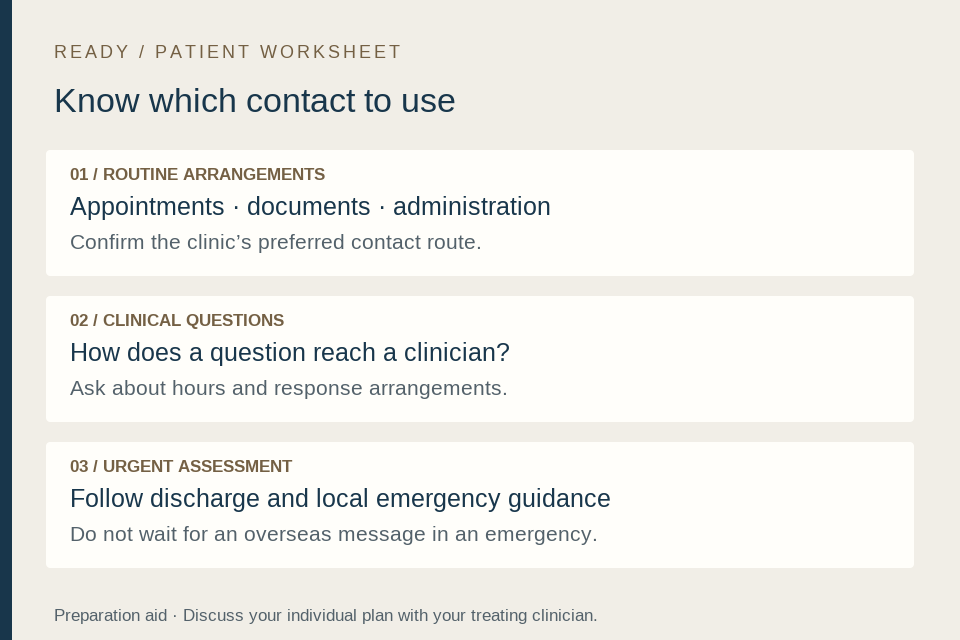
Separate three kinds of contact
First, identify the person or team responsible for routine administrative matters, such as scheduling a review or obtaining a document. Second, identify how a clinical question reaches a qualified clinician. Third, ask what to do when a concern needs urgent assessment. These routes may overlap, but you should not have to discover the difference for the first time when you are worried.
Ask the clinic to describe its normal response times and its out-of-hours arrangements. Clarify the time zone, the preferred language and whether a message is acknowledged automatically or reviewed by a person. Store the contact details somewhere you can access if your main phone or usual messaging account is unavailable. A printed copy can be useful alongside a digital one.
Do not assume that a marketing coordinator is always available or able to make clinical decisions. Ask who covers absences and whether another clinician can review your information if the operating surgeon is unavailable. This is a request for clarity about responsibility, not an accusation that something will go wrong. A practical plan is specific enough that you and a companion can follow it.
Know when a message is not enough
Seek urgent local assessment for new pain and swelling in one leg, which can be symptoms of a blood clot. Sudden difficulty breathing, new chest pain or fainting needs emergency help, even without leg symptoms. Use local emergency services immediately. Do not wait for your next scheduled review or for a reply from Korea. This is a warning to obtain assessment, not a diagnosis; symptoms can have different causes. [5], [7]
Redness and pain around a surgical wound, drainage or fever can indicate infection. Contact a healthcare professional promptly if these occur, following the urgent-care instructions you were given. Do not wait to collect every document or a perfect photograph before seeking help. Tell the assessing clinician where and when you had surgery, what was done and which medicines you have taken. [2], [6]
Ask the surgical team before discharge which changes are expected after your particular procedure and which need prompt review. Write down the local care route as well as the clinic contact. If you cannot reach the clinic, that should not leave you without a way to obtain assessment. These examples are not a complete symptom checklist and do not replace your personal discharge instructions.
Understand the limits of remote follow-up
A video call or photograph exchange may be useful for communication, but it does not replace every physical examination. Ask which planned checks can be done remotely and what findings or symptoms would require local assessment. The team should explain its own limits rather than leaving you to decide whether a photograph contains enough information.
Ask for instructions on how to submit updates if the clinic uses them: what information to include, which route to use and how to identify the date of an image. Keep original files where possible. Avoid filters or edits that change the appearance of the area being reviewed. Do not post personal medical photographs publicly simply because a private clinical channel is inconvenient.
If you receive an unclear answer, ask what the next action is and who is responsible for arranging it. A message that something should be checked is incomplete until you know whether the clinic wants another remote review, an examination in Korea or assessment where you currently live. Do not interpret silence as reassurance or a routine photo review as permission to ignore a new concern.
Plan access to care where you live
Before treatment, consider who you would contact for medical help after returning home. Ask an appropriate local healthcare service how postoperative concerns after overseas treatment are assessed and what information it would need. Availability, charges and referral arrangements differ between countries and services. Do not assume your regular doctor has agreed to provide a particular type of surgical follow-up.
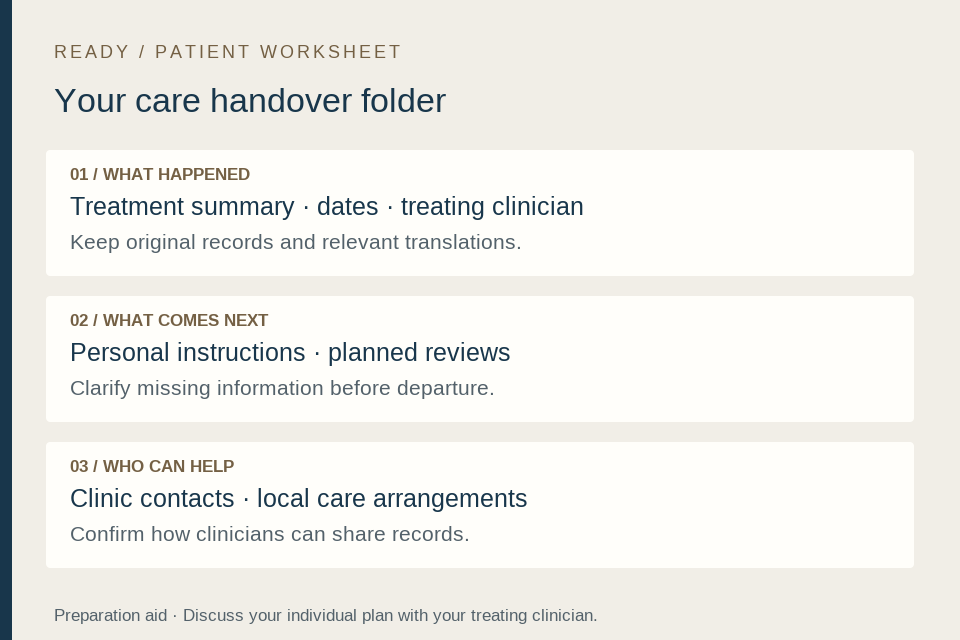
Ask whether the Korean clinic can communicate with a local clinician if needed and how you would authorize sharing records. Keep the names and contact details of both services together. A handover is easier when the receiving clinician can understand what treatment occurred, rather than relying only on your memory of procedure names or a translated promotional description.
The CDC’s medical-tourism guidance emphasizes planning for complications and continuity of care, including access to relevant records. It is a general resource about treatment abroad, not an evaluation of READY’s listed clinics. Use it to organize a conversation about the care available to you, without assuming that a clinic listing or international website guarantees a coordinated handover. [2]
Collect a useful discharge folder
Ask which records the team will provide before you leave. Depending on the treatment, relevant documents may include a treatment or operation summary, discharge instructions, medicine information, and details of implants or other materials used. Ask for copies in a form another clinician can read. Preserve original-language documents alongside any translation instead of replacing them with an informal summary.
Check the basics while you are still at the clinic: your name, treatment date, treating clinician and contact information. Ask about unfamiliar abbreviations and confirm how you can obtain missing records later. A folder that looks complete but contains only appointment receipts and marketing information may not answer a receiving clinician’s questions about the actual procedure.
Keep the postoperative instructions separate from general articles you saved during research. If advice conflicts, ask the treating team to clarify rather than selecting the instruction that seems easiest. Do not change prescribed medicine or care routines on the basis of this guide. Your records should help clinicians coordinate your care, not encourage you to manage a complication without assessment.
Who owns a test result that comes back after your flight?
If a test was performed near the end of your stay, ask whether the final result is back. A discharge report can be complete for the day it was written while a laboratory result is still pending. Before you leave, note the date, the name of the test, the facility holding the result and the clinician who will contact you. Ask when the team expects to know more and what to do if no message arrives. If nothing is pending, you can record that answer too.
For example, if the team took a wound sample, ask for the sample date and location, medicines already given and how your local clinician can obtain the final report. Brand names can differ between countries. Ask the team to record the medicine’s generic name, dose and dates as prescribed. Provide these to the clinician assessing you at home. Avoid starting, changing or extending antibiotics on the basis of a translated lab result you read yourself.
If you become unwell, tell local clinicians promptly about the exact operation, date and location of care, including any return visits or treatment for a complication. The CDC highlights infection and antimicrobial resistance as considerations after medical travel. Those concerns help the clinician choose an evaluation; they do not establish that you have an infection. Seek necessary local assessment without waiting for overseas files. Once you are receiving care, ask who will communicate with the original clinic and how you will hear the plan.
CDC Yellow Book guidance on medical tourism and returning patients
Keep travel clearance separate from the itinerary
Ask the treating clinician when and how fitness for travel will be assessed. Explain the length and stages of your journey, not only the date of departure. Ask whether the plan changes if you need an additional review or if your recovery differs from what was initially expected. Allow practical flexibility for those possibilities when arranging flights and accommodation.
Surgery and long-distance travel can both be relevant to blood-clot risk. General advice cannot calculate your personal risk or select a safe departure date. Discuss your health history and journey with the treating team, and follow individualized instructions. Do not treat an online minimum number of days, another patient’s departure date or an airline booking as medical clearance. [1], [2]
Ask whether any airline documentation is needed and who would supply it. Airline requirements and clinical advice are separate matters; meeting one does not automatically satisfy the other. Keep time to resolve paperwork, collect medicines according to applicable travel requirements and obtain the final records the clinician expects you to carry. Confirm these details directly with the relevant services.
Budget for responsibilities outside the original package
Request a written explanation of what the clinic includes if you need an unscheduled review, additional treatment or a longer stay. Ask about the difference between a clinic fee policy and the cost of accommodation, travel or care elsewhere. A promise to discuss a concern does not necessarily mean every related expense is included.
Check your insurance directly with the insurer before travel. Tell it that the trip involves planned treatment and ask about the particular cover you need, including complications and changes to travel plans. Do not rely on a general travel-policy title or assume that emergency assistance includes all consequences of an elective procedure. Keep the written answer with the policy documents.
The NHS treatment-abroad checklist highlights appropriate insurance and the possibility of extra accommodation or return-trip costs. Those are reasons to plan a contingency, not verified prices for your treatment. If the financial plan leaves no room for an unexpected review or changed departure, consider whether you need more time before committing. [3]
Make language support work after the consultation
If you need interpretation, ask whether it covers discharge instructions and later clinical communication as well as the initial appointment. Confirm which language will be used for written instructions and whether translations are available for records a local clinician may need. A multilingual website does not by itself establish a staffed interpretation service at every stage.
Read back the practical plan in your own words before leaving. Explain whom you would contact for a routine question, where you would seek an urgent assessment and when your next review is scheduled. Ask the team to correct any misunderstanding. This simple check can reveal an unclear instruction without requiring you to understand every medical term in the discharge document.
If a companion is helping you, decide which information they need and whether you want them included in the discharge discussion. Keep your own access to the records and contact details. Do not leave the entire plan inside someone else’s phone, a temporary travel account or a messaging thread you may struggle to find later.
A listed clinic to ask about continuity of care
Good-Line Plastic Surgery is one of the clinics listed on READY. Use its profile and international website to ask whether the proposed care includes language support, translated discharge information or communication after you return home. Confirm each arrangement, its availability and any charge directly rather than assuming these services are included.
Review the Good-Line profile and Dr. Choi’s profile, then use the clinic’s international website to ask for a written follow-up outline. Ask specifically which reviews must occur in Seoul, who answers clinical questions after departure and how the clinic would share records with a clinician near your home.
A clinic listing is not an independent ranking or a guarantee of aftercare. Published descriptions are a starting point for verification. Your decision should depend on the actual agreed plan and your access to care, not simply on the fact that a clinic advertises international-patient support.
Before you leave the clinic
Bring the plan together in one place: the next appointment, the clinician’s travel advice, your care instructions, records, routine contact route and urgent-care instructions. Confirm which outstanding documents will be sent later and how you will obtain them. Ask the team to clarify any remaining uncertainty before you are separated by a flight and a time difference.
What if I develop an urgent concern at home?
Seek timely local medical help rather than waiting for an overseas messaging response. Follow your discharge instructions for urgent symptoms, and use local emergency services for severe or immediately threatening symptoms. Tell the assessing clinician about the recent surgery and provide the records you have. Contacting the original clinic can support care but should not delay urgent assessment.
Does remote follow-up mean I will never need another examination?
No. Ask the clinic which situations can be reviewed remotely and which require an examination. A remote service is a communication arrangement with limits, not a promise that every concern can be managed through photographs or video.
Can I use the clinic’s usual package itinerary?
Treat it as an initial administrative proposal. Confirm it against the treating clinician’s review schedule and personal travel advice, and allow for changes. READY’s Seoul trip-planning guide covers the broader preparation, while the consultation checklist helps you keep these questions together.